
How to Build an AI Agent for Healthcare
Building an AI agent for healthcare takes more than a great model. Here is your step by step guide to designing, deploying, and governing a production-ready healthcare AI agent in 2026.
Keshav Gambhir
7/16/20267 min read
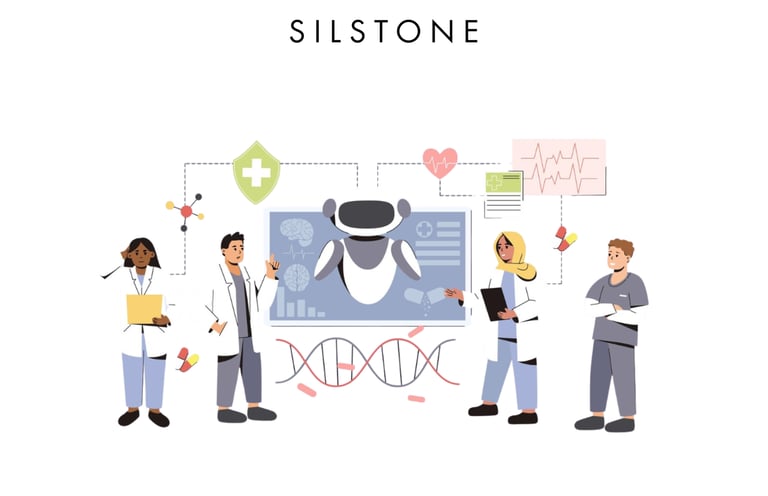

Healthcare has always been data-rich and time-poor. Clinicians spend nearly half their workday on documentation and administrative tasks instead of patient care. Hospital systems process millions of prior authorization requests that take days when they should take minutes. Patients wait on hold to schedule appointments that a well-designed system could book in seconds.
AI agents are changing this. Not the chatbots of five years ago that could answer a FAQ or confirm a booking, but genuinely intelligent systems that can perceive clinical data, reason through complex scenarios, execute multi-step workflows across connected systems, and adapt when conditions change. In 2026, building an AI agent for healthcare is no longer an experimental exercise reserved for large hospital networks. It is a practical, achievable move for any health tech team that wants to build something that delivers real clinical and operational value.
This guide breaks down exactly how to do it right.
What an AI Agent in Healthcare Actually Is
Before diving into the how, it is worth being precise about what a healthcare AI agent actually is, because the term gets used loosely in ways that create confusion.
A traditional chatbot follows predefined rules. If a patient types a specific phrase, the bot returns a specific response. It cannot reason, adapt, or take action beyond its scripted pathways.
An AI agent is fundamentally different. A classifier might tell you that a patient is at high risk. An AI agent reads that risk score, checks the scheduling system, sends a follow-up message to the patient, updates the EHR, and alerts the care team, all in one automated sequence. It perceives information, reasons over clinical context, decides what action to take, and executes that action with minimal human intervention at each step.
This distinction matters because the architecture, compliance requirements, and development approach for a true AI agent are significantly different from what is needed for a simpler automation tool. Getting that architecture right from the start is what separates agents that reach production from ones that stay stuck in pilot.
Step 1: Define the Specific Workflow You Are Automating
The most common mistake teams make when building healthcare AI agents is trying to automate too much too soon. They set out to build a general-purpose clinical assistant and end up with something that does nothing particularly well.
The right starting point is a single, specific, high-volume workflow with a clear pain point. The more manual steps involved in the current process, the bigger the opportunity for automation and the easier it is to demonstrate measurable ROI after deployment.
The workflows that deliver the most immediate value in 2026 are well documented. Administrative errors contribute to a significant share of claim denials, and manual prior authorization processes cost healthcare providers an estimated $25 billion annually, with automation capable of cutting that cost by up to 80%. Patient no-shows cost the US healthcare system $150 billion per year, and AI-assisted scheduling with automated reminders has proven highly effective at reducing that number. Clinical documentation is another major opportunity, with one health system reporting a saving of 66 minutes per provider per day after deploying ambient scribing AI that listens to patient encounters and generates structured notes in real time.
Pick one of these workflows. Define the specific inputs your agent will work with, the specific actions it will take, and the specific outcome you are measuring. That definition becomes the foundation your entire architecture is built on.
Step 2: Design Your Architecture Around the Four Core Layers
A production-ready healthcare AI agent is not a single model. It is a system of interconnected layers that work together to deliver reliable, compliant, and clinically useful output. Understanding these layers before you write a line of code will save you enormous amounts of rework later.
The first layer is the data and integration layer. This is where your agent connects to the systems it needs to operate: EHRs, scheduling platforms, claims systems, patient portals, and diagnostic databases. In 2026, FHIR-based APIs are the standard for healthcare data exchange, and your agent's ability to communicate with existing infrastructure through FHIR will determine how broadly it can be deployed. A healthcare AI agent that cannot connect cleanly to the EHR systems your buyers use is an agent that cannot be deployed.
The second layer is the PHI classification and governance layer. Before any patient data enters your AI pipeline, every field that constitutes protected health information must be identified, tagged, and governed. This requires automated classification that propagates downstream through your data pipelines. When a new field is added to an EHR feed, it needs to be evaluated and tagged before any agent can query it. This layer is what makes your agent defensible in a compliance audit.
The third layer is the reasoning and inference layer. This is where the agent processes information, understands clinical intent, and generates recommendations or actions using a large language model. The quality of your reasoning layer depends heavily on how well you have designed your context delivery. AI agents perform significantly better when provided with accurate, relevant clinical context rather than relying solely on model training data. Retrieval-augmented generation, patient history integration, clinical guideline retrieval, and organizational knowledge bases all contribute to better reasoning output.
The fourth layer is the action and orchestration layer. This is where the agent executes. It calls APIs, updates records, sends messages, schedules appointments, and escalates to human staff when it encounters a situation that requires clinical judgment. Designing your escalation pathways is as important as designing the automated workflows themselves. A well-designed healthcare AI agent knows exactly when to hand off to a human and does so with full context, so the handoff is seamless rather than disruptive.
Step 3: Build Compliance Into the Architecture, Not On Top of It
HIPAA compliance is not something you layer onto a healthcare AI agent after you have built it. It is a set of requirements that need to be embedded into every architectural decision from the beginning.
HIPAA applies to any system that accesses, uses, or discloses protected health information, and AI agents that operate in clinical settings are fully subject to its requirements. The key obligations for healthcare AI agents include minimum necessary access controls that limit PHI access to what is needed for a specific task, audit trail logging of every PHI access event, and business associate agreements with every AI vendor handling patient data.
The minimum necessary standard is particularly important for agentic systems because agents tend to retrieve more data than they need. An agent scheduling a follow-up appointment might pull a full patient chart when all it actually needs is the patient's name, provider, and preferred time slot. Designing your retrieval layer to enforce minimum necessary access is not just a compliance requirement. It also makes your agent more accurate and less prone to surfacing PHI in outputs where it does not belong.
For teams building in Canada, the compliance requirements layer on top of HIPAA rather than replacing it. PHIPA, PIPEDA, and provincial data residency requirements all apply, and your architecture needs to account for them from the start. The data residency requirements in British Columbia and Nova Scotia mean that any agent handling health data from residents of those provinces needs to be hosted on Canadian infrastructure.
Step 4: Start With a Pilot on a Single High-Impact Use Case
Even with a well-designed architecture, deploying a healthcare AI agent across your full user base from day one is a high-risk approach. The right deployment strategy starts with a structured pilot on a single workflow in a controlled environment.
A successful pilot has three components. First, a clear baseline measurement of the current state. How long does the manual process take? How many errors occur? What does it cost? Without a baseline, you cannot demonstrate the value your agent delivers.
Second, a parallel run period where the agent handles a portion of the workload alongside your human team. This lets you identify gaps in your reasoning layer, edge cases your architecture did not anticipate, and escalation scenarios that need better handling before you scale.
Third, a defined set of success metrics tied to the specific workflow you are automating. For scheduling, that might be call abandonment rates, no-show rates, and average booking time. For prior authorization, it might be processing time per request and denial rates. For clinical documentation, it might be time spent on notes per provider per day. Measuring the right things from the start is what turns a successful pilot into a business case for full deployment.
The companies that have done this well in 2026 started small and scaled based on evidence. Cohere Health now processes over 12 million authorization requests annually, but it got there by starting with a specific authorization workflow, proving the model worked, and expanding from a position of demonstrated clinical value.
Step 5: Build for Ongoing Governance, Not Just Launch-Day Compliance
One of the most underinvested areas in healthcare AI agent development is what happens after deployment. Clinical data changes. Patient populations shift. New regulations come into effect. Model performance drifts in ways that are not always visible without active monitoring.
Building governance into your agent from the start means designing the systems that will allow you to detect when your agent is underperforming, understand why, and correct it without disrupting clinical workflows.
This includes monitoring systems that track agent performance in real time, alert your team when error rates or escalation rates exceed thresholds, and provide clear audit trails linking every action back to the rules and data that drove it. It includes regular evaluation cycles where your clinical and engineering teams review agent outputs together and identify areas where the reasoning is not meeting clinical standards.
In 2026, Canadian health systems deploying AI tools are increasingly asking vendors to demonstrate not just that their agent is compliant at launch, but that they have ongoing governance processes that will keep it compliant and clinically appropriate as conditions change. Designing for that from the start is what separates agents that maintain trust over time from ones that get decommissioned after a compliance incident.
What It Actually Takes to Build a Healthcare AI Agent That Reaches Production
The gap between a healthcare AI agent that looks impressive in a demo and one that actually reaches production in a clinical environment is wider than most teams expect. The demo version handles the happy path. The production version needs to handle edge cases, privacy violations, escalation scenarios, model drift, integration failures, and compliance audits, all while continuing to deliver value to the clinicians and patients it was built for.
Getting there requires a team with depth in both healthcare domain knowledge and AI engineering. It requires compliance architecture that was designed in from the start, not retrofitted after the fact. It requires a pilot strategy that generates the evidence you need to expand with confidence. And it requires ongoing governance that keeps your agent performing well as the clinical environment evolves.
Silstone Group works with health tech teams building exactly this kind of infrastructure, combining senior engineering talent, healthcare compliance expertise, and AI-assisted development workflows to help clients move from concept to production faster without the costly missteps that come from underestimating the complexity of the clinical environment.
Visit silstonegroup.com to learn more or book a discovery call
LINKS
Discover
© 2026. All rights reserved.